

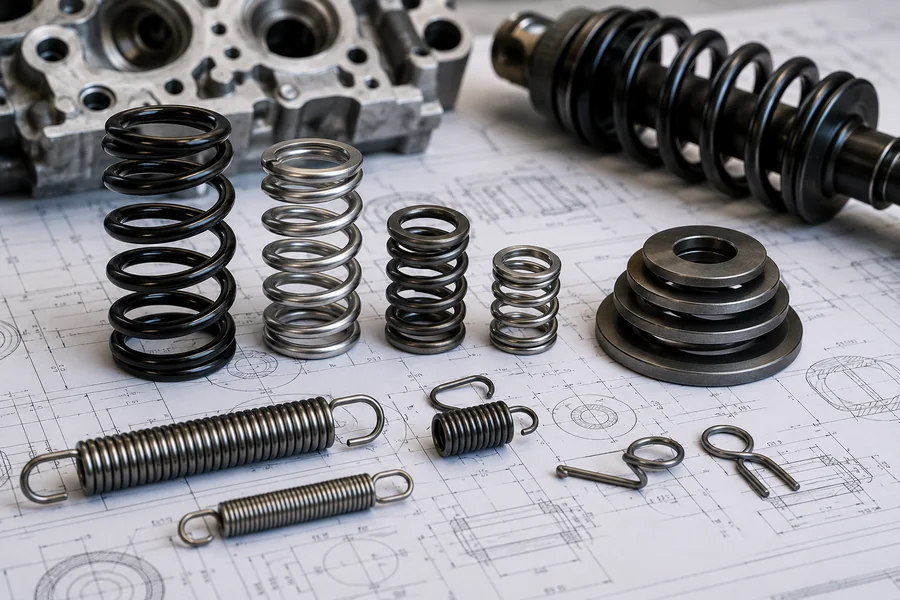
Hagens A/S designs and manufactures custom springs for industrial and automotive applications where standard off-the-shelf components cannot meet the required load, dimensional, or performance specifications. Their range covers compression springs, tension springs, and disc springs, all built to customer specifications and delivered as a global supplier.
When standard springs fall short
Catalogue springs work fine for general-purpose assemblies. But automotive engineering rarely stays general-purpose for long. The moment a load profile deviates from linear, or a spatial envelope shrinks below what stock dimensions allow, the standard part becomes a liability.
Three conditions typically push an engineer toward custom specification: the required spring rate falls between catalogue increments, the installation space forces non-standard free lengths or outer diameters, or the fatigue life demanded exceeds what a generic part can guarantee. When two or three combine — as they often do in powertrain or suspension components — catalogue browsing becomes a waste of time. Hagens operates as a global specialist manufacturer for exactly these situations. Engineers can review the available approach at Hagens.com.
Load requirements and dimensional tolerances
Load specification is where custom spring engineering begins. In automotive contexts, the relevant question is “what load curve across the full stroke, at what temperature, after how many cycles?” The load tolerance band matters as much as the nominal value.
Dimensional tolerances create the second constraint layer. A spring that meets load requirements at 14mm outer diameter is useless if the bore measures 13.5mm. Automotive housings are machined to tight tolerances, and the spring must fit within those limits while delivering the correct mechanical response.
Compression springs offer the most flexibility through wire diameter, coil pitch, and active coil count adjustments. Tension springs are geometrically more constrained because hook or loop ends consume axial space. Disc springs occupy a different territory — a single disc can deliver very high load in minimal axial space, making it the natural choice when the design envelope is flat rather than cylindrical.
Parameters worth defining upfront: maximum allowable installed height, load tolerance at working height, continuous temperature range, and whether the load requirement is static, quasi-static, or fully dynamic. These shape material selection, heat treatment, and geometry simultaneously — getting them defined early avoids expensive iteration later.
Choosing the right spring type
Compression springs remain the default in most automotive subsystems — straightforward to manufacture, easy to inspect, and predictable under fatigue loading. Valve trains, fuel injectors, and clutch mechanisms all rely on them.
Tension springs suit return mechanisms and counterbalance systems. Their weakness is the hook, which concentrates stress and represents the most common fatigue failure point. Any automotive application demanding more than 100,000 cycles needs careful hook geometry specification.
Disc springs solve a problem the other two types cannot. When you need 500N or more in under 3mm of axial space, stacking disc springs in series or parallel delivers that capability. Suspension preload, brake caliper clamping, and transmission clutch packs all use disc springs for this reason.
Matching spring type to application is about physics, not preference.
How Hagens structures the customisation process
The process begins with the customer’s application data. Engineers submit their load, dimensional, and environmental requirements, and design collaboration starts from there. Material selection, wire cross-section, surface treatment, and end configuration are all developed iteratively.
A compression spring for a turbocharger wastegate and one for a seat latch mechanism share almost nothing beyond the category name. Products are manufactured to international standards and delivered to the customer’s final specification. (Source: https://hagens.com/custom-springs/)
Durability as a design criterion
Specifying a spring that meets load and dimensional requirements on day one is half the job. The other half is ensuring it still meets them after 10 million cycles at 120 degrees Celsius. Material grade, shot peening specification, surface coating, and stress ratio all feed into fatigue life predictions — a spring operating at 80% of its theoretical shear stress limit will fail orders of magnitude sooner than one operating at 60%.
Before signing off on any custom spring design, confirm these parameters:
- Required fatigue life in cycles (with safety factor stated)
- Continuous operating temperature range and peak temperature exposure
- Corrosion environment (salt spray hours, chemical exposure)
- Surface treatment specification (shot peening, coating type, plating)
- Maximum allowable relaxation as a percentage of initial load
Which applications justify the custom route
Not every spring in a vehicle needs to be custom manufactured. Modified standard parts handle many applications adequately, particularly low-cycle or non-critical assemblies.
Custom becomes the clear engineering choice when the load tolerance band is tighter than catalogue offerings can guarantee, the installation geometry prevents use of standard dimensions, fatigue life requirements exceed 1 million cycles under actual operating stress, or the environment demands material and surface treatment combinations that stock parts do not carry. When two or more of these conditions overlap, the case for working with a specialist manufacturer like Hagens is straightforward.
