

Right from the start, we’ll state it point-blank – new product development (NPD) is a tedious process of several stages, and rest assured you need different experts working together on your product. From developers, engineers, and designers, all the way to marketers and people in sales – they are all involved and working towards one cause – the successful launch of the product.
But titles, professions, and expertise can get a bit confusing in product development. Who are the industrial (product) designers sketching the sleek aesthetic design of the product? And why are they often quarreling with mechanical engineers who seemingly botch the industrial design in order to successfully and safely implement the product’s functionalities?
In this article, we’ll illustrate the job the industrial designer does, and the roles the mechanical engineer performs.
Spoiler alert! While the former is more focused on beauty, the latter is all about functionality. And honestly, when those two concepts mesh together into one visionary product, isn’t that the most awe-inducing thing?
Let’s start.
Main Differences Between Industrial (Product Designers) and Mechanical Engineers
When you’re dealing with product design, it’s a constant balance act between form and function.
The “form” part is the mentioned beauty aspect the industrial designer handles. Okay, not just beauty. Industrial designers take into account ergonomics (in the case of hardware products) and the ever-important user experience (UX). They are creatives who keep the user in mind. While they tackle frontend aesthetics and UX questions such as accessibility, they also try to make the mechanical engineer’s job a bit easier by calculating, right from the start, factors of ruggedness and performance in harsh environments. So while they do, traditionally, focus on form, they don’t completely ignore the “function” part of it all.
Now, mechanical engineers are ALL about function. Any decent mechanical engineer strives to assure reliable function while paying attention both to regulatory and legal demands, as well as customer needs. Mechanical engineering is thus more detailed, procedural, and focused on staying within the budget. Being cost-effective also means that mechanical engineers aim to minimize part count during manufacturing and lower complexity where so doable.
There is this running gag that industrial designers come to mechanical engineers with outlandish product designs only to see their ideas botched in order to make way for practicality. But, as it is in life, the truth is somewhere in the middle. At times someone needs to pull the reins on industrial (product) designers and bring them down to earth. And at times someone needs to nudge mechanical engineers into a more daring and visionary zone.
We should keep in mind that, in some product development processes, one or the other expert will play a bigger role. For instance, if the product is a new camera or a smartphone, the industrial (product) designer will be more in charge. That is because UX and other aspects of human interaction need to be taken into account. Since it’s not always easy to determine who needs to take the front seat for a while, you can always seek out a product development consultancy that has a vast roster of talent in both industrial designers and engineers, and a track record that makes them suitable to advise you on the way to launch your product.
In Which Product Dev Phase Should Industrial Designers and Mechanical Engineers Begin to Collaborate?
The product development cycle is most often broken into 7 cycles:
- Idea Generation
- Idea Screening
- Concept Development and Testing
- Business and Marketing Strategy Development
- Product Development
- Test Marketing
- Commercialization
And yes, product designers and engineers should already start working closely together during the first phase. During Phase Zero, the team needs to comprehend the problem the product aims to fix, dot down product requirements, and lay out the scoping activities. When this “pre-phase” is done, you should have the answer to the question “What product are we developing here?”
Once you’ve completed the product definition activities of Phase Zero, it’s time for Phase One.
This phase is important because both industrial designers and engineers take the research and concepts from the pre-phase and use them to start forming a working prototype. That is why we call this phase the “proof-of-concept” phase. The team works to de-risk the most questionable parts of the product, and prove that the product can be brought to realization.

For this phase to kick off correctly, the designers should be fed the product requirements. Then they deliver the product’s design features. Here is where the process circles back to the engineers who create a rough computer-aided design (CAD) and an early prototype design.
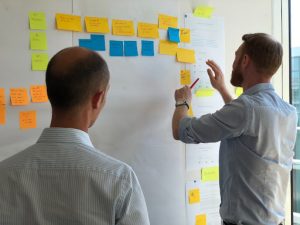
Then the real collaboration starts to take shape – while the designer creates the product sketches, the engineer feeds them directly information as they learn more about the primary functions of the product.
So when tweaking a product dev cycle for your needs, make this phase an iterative, collaborative, and evolutionary process.
Beginnings are often frustrating. But they are also inspiring. For instance, Phase One really encourages innovation. Through iterative development, testing and prototyping, industrial designers and engineers help each other come up with sleek and cost-effective designs that meet the product’s requirements.
Final Word
There is no need to sacrifice form over function, or vice versa. Successful product development is a balancing act that uses a multi-disciplinary approach. In today’s world, coming across commodity products or B2B products that are both affordable and modern in design and UX is not that uncommon.
And not only is it often seen these days – it’s celebrated. After all, we live in a consumerist society that is just now waking up to the urgent need to be more sustainable in manufacturing, and more equal in allocating resources.
So, no, frontend creativity doesn’t come at the price of forgoing cost-effective materials and processes. Bring your industrial designers and mechanical engineers together to form a collaborative workspace where they can shape concepts and develop prototypes that will turn into well-received MVPs (minimum viable products). And in the end, you will get a successfully launched product that strikes the right tone of the end user’s perception of quality.
